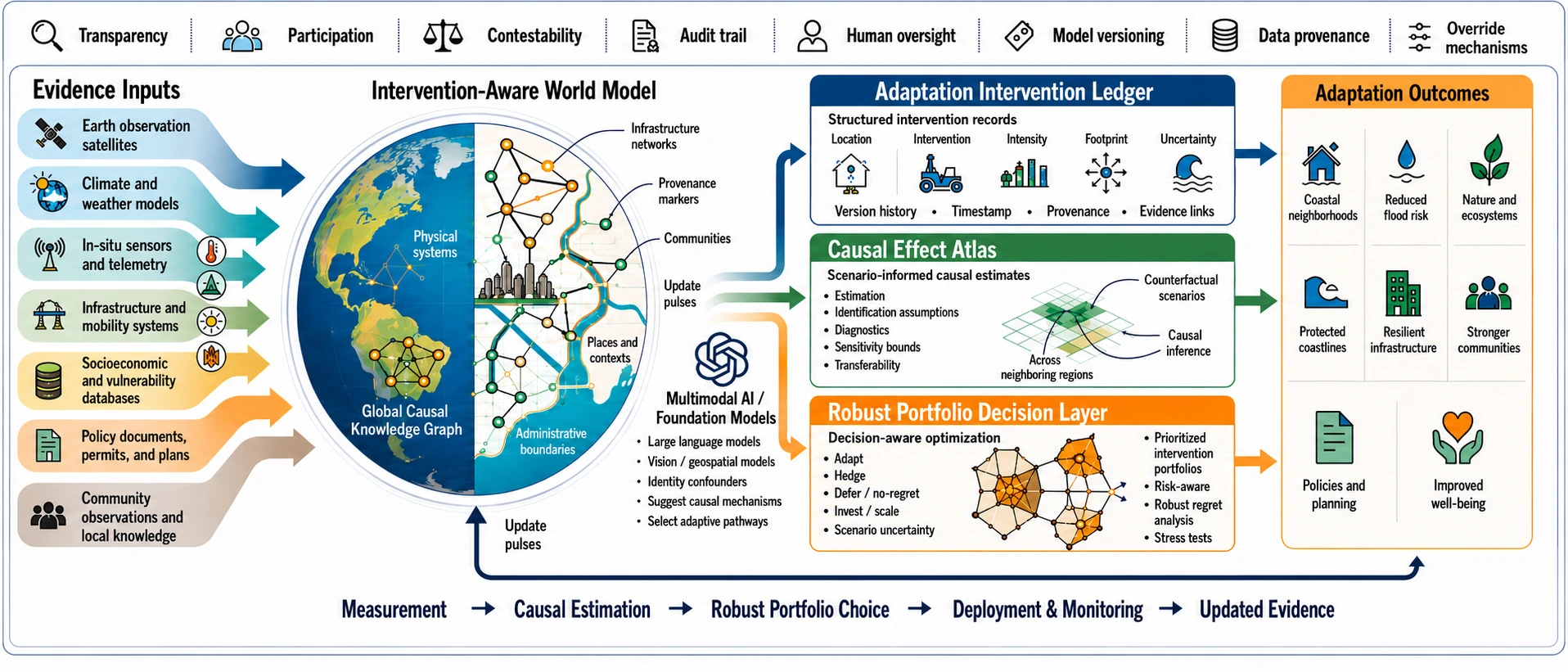
A field-level provocation: move climate ML from read-only hazard intelligence to auditable decision support for adaptation.
PCA-OS organizes planetary adaptation around an intervention-aware world model and three shared, auditable artifacts — a continual loop of measurement → causal estimation → robust portfolio choice → deployment & monitoring → updated evidence.
Abstract
Predictive climate machine learning is increasingly good at forecasting hazards, but hazard maps alone do not decide what to do, where, when, for whom, and under which futures. We argue that climate ML remains insufficient for adaptation unless interventions become first-class, versioned, and auditable objects. Many climate digital twins still prioritize state estimation and simulation, whereas adaptation requires intervention observability, counterfactual effect estimation, and constrained portfolio choice. We propose PCA-OS (Planetary Climate Adaptation Operating System), a decision-support operating abstraction built on an intervention-aware global causal knowledge graph. PCA-OS standardizes schemas, versioned updates, query primitives, and audit interfaces across three core objects: (1) an Adaptation Intervention Ledger recording measurable interventions with provenance and uncertainty; (2) a Causal Effect Atlas storing scenario-indexed, spillover-aware estimands, identification assumptions, diagnostics, and sensitivity bounds; and (3) a Robust Portfolio Decision Layer optimizing intervention portfolios under budget, equity, and no-harm constraints. Foundation models and intervention-aware world models should support, not replace, identification-aware causal analysis by surfacing candidate confounders, mechanisms, and spillover pathways for human review. We also outline AdaptBench, an evaluation suite where systems can fail for inequitable or maladaptive recommendations despite high predictive accuracy. The result is a field-level provocation: move climate ML from read-only hazard intelligence to auditable decision support for adaptation.
The Provocation
The climate-ML stack produces spectacular read-only futures. But adaptation is not won on hazard maps — it is won on interventions: which roofs are cooled, which drainage networks are upgraded, and which communities absorb spillovers. PCA-OS reframes adaptation as a continual learning and decision loop:
1Measurementinterventions observed from Earth observation (EO), documents, and operational traces
→
2Causal estimationscenario-indexed, spillover-aware effects with explicit assumptions
→
3Robust, equity-constrained optimizationportfolios under budget, equity-floor, and no-harm constraints
In this framing the primary scientific object is no longer the hazard map — it is the intervention object: first-class, versioned, causally evaluated, and contestable.
Three Core Objects
🧾 Adaptation Intervention Ledger
Records where and when interventions occur — location, timing, type, intensity, footprint — with joint uncertainty and provenance. Fuses EO change signals, SAR and event-response evidence, administrative and documentary text, and operational or participatory traces. Absence from EO is not evidence of no intervention: missingness, dispute status, and validator state are first-class fields.
🗺️ Causal Effect Atlas
Stores causal claims as explicit objects: scenario-indexed, spillover-aware estimands with identification strategy, diagnostics, sensitivity bounds, and transportability warnings. When mechanism, exposure range, or governance regime differ sharply, an effect is demoted from reusable point estimate to stress-test input — preserving usefulness without false authority.
📊 Robust Portfolio Decision Layer
Chooses portfolios of interventions rather than isolated actions, maximizing worst-case scenario welfare under budget, equity-floor, and bounded-harm constraints, scored by Robust Decision Regret. Every portfolio object retains pointers to the exact ledger versions, atlas entries, constraints, and human overrides it was derived from.
Interventions become ledger objects, then effect objects, then decision objects — uncertainty, provenance, and assumptions are carried forward at every step. A PCA-OS prototype fails if a recommendation cannot be traced back to specific intervention evidence, causal assumptions, scenario choices, and governance constraints.
Four Design Commitments
Decision-first. Primary outputs are intervention, effect, and portfolio objects rather than hazard maps alone.
Interventions as first-class objects. Actions are versioned, geolocated, uncertain, and causally queryable.
Uncertainty-forward. Measurement, identification, and climate-scenario uncertainty propagate into the decision layer.
Normative constraints as infrastructure. Equity, no-harm, and contestability are encoded inside the optimization and the interface — not post-hoc commentary.
Running Exemplars
🏠 Cool roofs for extreme heatThe minimum viable, city-scale deployment: detect parcel-level retrofits from EO and permit text, estimate avoided heat exposure with neighborhood spillovers, and optimize subsidy rollout under budget, equity-floor, and bounded-harm rules.
🌊 Flood defenses with spilloversLevees, drainage retrofits, and shoreline protection require interference-aware causal inference, because they can redirect water and externalize harm.
🌳 Urban greening & nature-based solutionsGreening reduces heat but can trigger green gentrification — joint models of cooling, amenity spillovers, and distributive outcomes are required.
🏭 Compound environmental burdensThe same object flow attaches adaptation choices to air-quality and logistics-burden outcomes when heat, ozone, traffic, and delivery systems shift risks unevenly.
AdaptBench
Evaluation must move beyond predictive accuracy. AdaptBench tests systems on three task families — and a system can fail for untraceable, maladaptive, or harmful decisions despite accurate hazard prediction:
Intervention mapping — produce calibrated ledger entries with uncertainty and provenance from EO, text, and operational signals.
Causal estimation — recover known and semi-synthetic effects under confounding while exposing estimands, identification notes, and diagnostics.
Portfolio choice — select interventions under budgets, equity floors, and no-harm constraints, scored by robust regret across scenario ensembles.
Splits stress generalization across space, time, and policy regimes. Each task ships an audit record linking evidence, ledger entry, effect object, portfolio decision, and failure labels.
@inproceedings{he2026pcaos,
  author    = {He, Chaoyue and Zhou, Xin and Wang, Di and Xu, Hong and Liu, Wei and Miao, Chunyan},
  title     = {{PCA-OS}: A Planetary Climate Adaptation Operating System},
  booktitle = {Proceedings of the 32nd ACM SIGKDD Conference on Knowledge Discovery
               and Data Mining V.2 (KDD 2026)},
  year      = {2026},
  address   = {Jeju Island, Republic of Korea},
  publisher = {ACM},
  doi       = {10.1145/3770855.3818654},
  isbn      = {979-8-4007-2259-2}
}
Acknowledgments
This research is supported by the RIE2025 Industry Alignment Fund–Industry Collaboration Projects (IAF-ICP) (Award I2301E0026), administered by A*STAR, and by Alibaba Group and NTU Singapore through the Alibaba–NTU Global e-Sustainability CorpLab (ANGEL).